Monday, November 14, 2011

Lunenburg Awaits!


I had a real adventure in Lunenburg Nova Scotia at the end of September. I went there to teach a workshop for the Lunenburg Art Association & Gallery. As I planned for this workshop, I was excited that I had a full class and I was looking forward to getting back to Nova Scotia. Pam and I spent part of our honeymoon there 11 years ago. Originally, she intended to go with me on this trip, but we also thought she would have a new kidney. Unfortunately, due to health insurance restrictions, traveling out of the country isn't possible for her at this time.

Interestingly enough, there were many little twists and turns to this trip across the border that made it quite the adventure. It all began with a leaky sunroof that I had tried to fix on my own in August. It seemed to all be fine until we had inches upon inches of rain with storm after storm and I had to start throwing a tarp over it in the driveway or else it would quickly become a Ford Escape with its own swimming pool. The rain stopped just long enough before I left for another attempt at solving the dilemma. The forecast called for lots of rain heading up north into Maine and then clear blue skies during the workshop week in Lunenburg. My last minute, 'what-the-heck...why not' idea was duct tape. I covered the sunroof edges with duct tape and I laughed at myself for even thinking this would work. The day I loaded up the car, there was no rain. None. That is, not until I left the driveway. Ten minutes on the road and the skies opened up like a water faucet. I glanced up at the corner of the sun roof where water usually pours in. Nothing.

I had given myself plenty of time to get up to Calais Maine on the Canadian border. It was a nine hour drive and it took me four hours to get to Wells Maine which usually only takes three. I stopped in Wells and called it a day. It was 10 PM. Driving in a pouring rain at night was making my head pound. There was still no leaking from my sunroof and the duct tape was holding surprisingly well. The next day I drove to Calais Maine. It rained on and off throughout the drive but at least it was daylight. I was excited to get to the border and I took a room at a small hotel. There was nothing of note in Calais except I was happy to have a decent room with a nice comfy bed and I caught up on some much needed sleep. The next morning I envisioned  driving across the border, then driving an hour or so to St John and taking the car ferry over the Bay of Fundy to Nova Scotia.

At 6:30AM the next morning, I pulled up to the Canadian Border. The conversation with the officer at the booth went something like this.

Border Officer: 'What brings you to Canada?'
Me: I am doing some painting and teaching a workshop.

Border Officer: 'Do you have a Letter of Invitation to come to Canada to teach this workshop?'
Me: 'No. What is that?!'

Border Officer: 'Do you have a Work Permit in order to come to Canada to teach this workshop?'
Me: 'No. What is that?!

Border Officer: 'Did the place where you will be teaching this workshop fill out a Labor Market Survey explaining why you need to come to Canada to teach this workshop instead of another Canadian?'
Me: 'NO AGAIN. What is that??!!! ##%^%$*

This had not gone quite as planned.! An hour and a half later, after spending what seemed like eternity explaining to the Immigration Officers 'WHY' I was trying to enter into Canada, I was signing a document stating that I would leave Canada 'Post Haste' and I was told not to return without the proper documents.

I am telling you this because, you should understand that crossing the border is not as easy as it once was. Before 9/11, I can remember driving into Canada looking for painting spots with George Carpenter and several cars of painters, only to NOT find what it was we were looking for and so back out we went. Then into Canada again at another crossing and back out etc etc. We did this 5 times or so. I doubt it would have been this easy if we were to try this stunt today.

So according to Canada, I was technically entering their country to 'work'. This was the major factor to my problem. The good folks in Lunenburg did not explain this paperwork and proper document information to me because some laws had recently changed and they did not know about them. They've had artists come in to teach for years without this paperwork. Back in my hotel room in Calais I explained all of this to them and they worked at getting what was needed for me to enter. In the end, I did indeed need a Letter of Invitation, but as a workshop or seminar (key word -seminar) instructor, guest lecturer and/or performing artist, I did not need a 'Work Permit' nor did the Art Association need to fill out the 'Labor Market Survey'. They faxed me the info as stated by law about teaching a seminar, lecturer or performing artist and I brought it with me the next morning back to the same border crossing. This time around, I was only there for maybe 15 minutes while the Immigration Officer went through some of his books and stared at my 'Letter of Invitation' for awhile. Finally he stamped my passport and I was welcomed into Canada and told to enjoy my visit. Yay.

Before this week is over, I will post part 2 of this workshop adventure.  It was a great group of students and there is much more to tell! I'll post some demo pics too. Here are a couple images of painting spots.




Thursday, October 20, 2011

Autumn Workshop


I've recently returned from an interesting and fantastic trip to Nova Scotia. I am in the process of writing about that experience and it will become my next post. This past weekend, I taught a plein air workshop in my hometown of Woodstock CT and I want to write about it today.

This workshop is an annual one to paint the Autumn color. This year, apparently due to Hurricane Irene dropping a ton of rain on us, which had a lot of salt in it from the ocean, the color is not as spectacular as I had hoped for. As a painter though, I am not really interested in a cacophony of bright colors all competing for a place on the canvas. A little bit of intense color goes a long way. We as painters, have the opportunity to tone down the color a bit to create harmony and we can brighten color where it is needed to help to create a focal point. If a painting is all full of bright color, nothing gets heard over all that loud noise. A canvas like this is hard to look at. For the person who is taking a scenic drive or walk, the bright colors can be cheerful and fun to take in. Hand that same viewer a painting done of this same scene done verbatim and he won't feel the same about it.

Harry Ballinger said in his landscape book that the peak of Autumn harmonized better when painted on an overcast day or could be better unified when painted in a back-lit situation. These are excellent points to consider. I personally prefer to paint the early Autumn color or late Autumn when the trees have lost a lot of their leaves and I can see through the foliage. A scene like this attracts me because their is still some bit of Autumn color that plays off the beautiful purple tones that make up the distance.

This was a three day workshop. Students were given the option of participating  for one, two or all three days. Everyone liked having these options and I am considering doing more of this. I would love to hear feedback. It appears that everyone has such busy lives these days and although someone may want to register, they can't always make the commitment for the full number of days. Students who came for just one day of this Autumn Workshop were very pleased with this option and confided that they got a lot out of the one day. One student said that she was taking home a lot of new ideas.

On the first day we had an extremely rainy day and I brought everyone into the studio for the day. This makes the most sense on a day like this. There are plenty of points to discuss about the painting process and an indoor demo is always well received by students. I chose a photo reference of a complicated scene that had a lot of potential for a good painting but needed some thought behind the final idea. I am reminded about a James Whistler quote: "To say to the painter that Nature is to be taken as she is, is to say to the player that he may sit on the piano!"

In the name of 'simplicity' I made some changes as I composed the painting. As part of the 'less is more' belief system that I have, it is my sincere hope to get at something in the simplifying of a subject that will say and feel more about that subject than the subject itself. It doesn't always happen, but when it does it is special. It's why I paint. Here is another quote, this time by Thomas Eakins: 'In mathematics the complicated things are reduced to simple things. So it is in painting.' And Albert Einstein said, 'Out of clutter, find simplicity'. And the kicker of them all is this one, also by Einstein: 'Everything should be made as simple as possible, but not one bit simpler.' Eureka! Now THAT is what painting is all about!

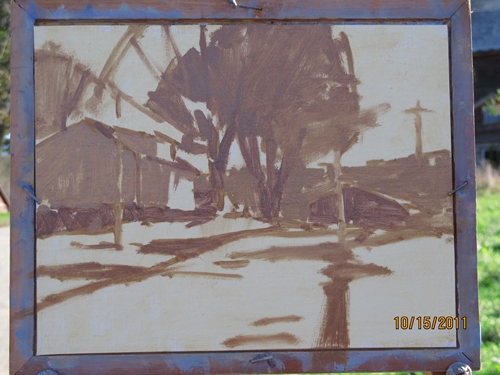
I'm putting up some images of the indoor demo and also one of the outdoor demos. In the first demo you can easily see the changes compared to the photo reference. I played up the size of the larger building and played down the size of the barn to the left. I did this for the sake of balance. If things are too similar in size, they cancel each other out. The big describes the small and the small describes the big. Emile Gruppe was a master of this idea. I avoided some of the clutter of the hodgepodge of trees to the right and gave the viewer some room to see beyond. I exaggerated the angle of the shadow to the left and also the dark shape near the stone wall, all for the sake of getting the viewer into the picture. I toned the linen canvas with raw sienna and then I blocked in the painting with raw sienna and a hint of purple. I wanted to show the relationship of the big shapes and to strike a well composed balance with my dark and light pattern. This my 'big idea'. I always think about someone saying..Hey! What's the big idea? ..The big idea in a painting is what makes the painting work. It holds it all together.


Here is an outdoor demo that I painted on Sunday morning. This was a quick one and I really stressed the importance of the big relationships.


Monday, October 10, 2011

The Maine Experience - Part 2


I have been travelling for weeks, teaching and painting in Maine and in Canada. I've had no real access to the Internet, so my idea of keeping up with my blog in real time has just been impossible. I apologize for such a delay in posting, and now plan to get caught up and post on a regular basis again. Thanks for being patient with my travels!

Here is part two of my painting trip to Stonington Maine. It includes good info about making the most of a painting trip and I hope you find it useful.

Pacing myself on any painting trip is important. I think there is a logical rhythm to it that if adhered to will make for a successful time. I used to go on painting trips and try to paint EVERYTHING. Then after a few days, I was exhausted and would find later that I could have done better if I had slowed down the pace and had spent the time to think more about my subject matter. In the book, A Sense of Place: The Artist And The American Land, by Alan Gussow, there are wonderful essays that explore the complex relationship between the artist and the landscape. I highly recommend this book as a way to understand how important it is to connect with whatever it is you are painting.

Here is a link.  http://www.amazon.com/Sense-Place-Artist-American-Land/dp/1559635681

For me on this trip to Deer Isle, I arrived late on a Monday night after an 8 hour drive. I had six full days to get work done. I had to talk to myself and resist the urge to jump out of bed that first morning and attempt to  try and paint everything and anything under the sun. I have learned to pay particular attention to spending some time just looking and thinking before diving into painting. Armed with a decent digital camera and a sketch book, I like to rise early and spend time photographing and making thumbnail drawings of what I am seeing. It is all part of becoming familiar with a place. Doing this, I get a sense in this particular case about how really big this harbor is and how many boats are always coming and going. I learn that the lobster boats head out about 4:30 A.M. and start returning to unload their catch around 11:30 A.M. This goes on all day until around 5 or 6 P.M. Lobster boats return and unload at 4 different docks. As the day goes on, it becomes a real dance. One boat comes in, while several others weave and bob while waiting their turn and so on. After they unload, the lobstermen head back to their mooring spot to tie up their boat and then come back in on their skiffs. It all becomes part of the big dance. On the docks, several men are helping to unload the catch. Here is a picture that I think will help get the point across about how dance-like this all is.


All the while, I am snapping picture after picture and making some quick drawings. I'm excited by all that I am seeing and I really can't wait to paint. All day long I have painted numerous ideas in my mind. Seeing a painting in your minds eye is half the battle and can produce some well executed paintings. I'm like a hunter/gatherer. I want to come home with some good paintings but I also want many more ideas for future paintings that can be worked on later on in the studio.

On this trip I had a weather forecast that called for an entire week of sunny weather. The tides were also in my favor and my trip was planned with the tide charts in mind. I want to paint the docks and the boats when the tide is at it's lowest or at least somewhere inbetween low and high tide. Painting at the highest tide would be of importance if my goal was to paint surf, but for this subject matter, painting it at high tide would not excite me. All week long, I had a low tide in the early morning and then again in the late afternoon or very early evening. It was picture perfect.

With that being said, let me reiterate a point here. I came home with many paintings. I came back with numerous drawings and a lot of photo references, but I mostly came back with IDEAS. Now I am looking forward to spending the time to paint a cohesive body of solid work from what I've done out there.

George Carpenter used to tell me that I should hold onto more of my outdoor work in order to make more and better work from them. Especially with the idea of going bigger. This is precisely what I am doing more and more of. I spend about half my week painting outside and the other half hunkered down in my studio.

Here are a few of the quick paintings I did on location. These images will give you an idea of the varied subject matter and the feel of Stonington Maine.


Thursday, September 22, 2011

The Maine Experience - Part One


I am suddenly jolted awake by a cacophony of strange whirring sounds all around me. I fly out of bed and glance at the clock. It is 4:30 A.M. I run over to a large picture window and pull up the blind so I can see what the heck is happening. I see lights, hundreds of them. In the dark, they appear to be hovering in mid-air.

It's not what your thinking. I am in Maine and what I am experiencing first-hand is not an encounter with strange beings from another planet but the Lobstermen of Deer Isle, Stonington, heading out from the harbor for another day on the water. It's a really big harbor and from my apartment for the week I have a view that overlooks a big portion of it. I have two large picture windows, one that is a view looking southeast and one that faces more west. I am here on a painting trip and these are views that will serve me extremely well for the next 7 days. Fully awake now, I sit and I watch as the hundreds of lights move about on the dark water. Eventually they become tiny specks far out on the horizon. The engine sounds that were filling up the air are now a quiet murmur barely audible from such a great distance.

My adventure here to paint in Maine for the week was planned months ago. With a full schedule of teaching plein air workshops and most of my evenings being taken up with doing home dialysis for my wife Pam, it was agreed that I would go somewhere and get some serious painting time in by myself. I needed to recharge my batteries. Pam would schedule getting dialysis at her center and I would concentrate on painting the boats and harbor. Nx Stage home dialysis has a high burn out rate and we are both determined to keep that from happening.

Just trying to make this trip a go, was an experience all by itself. Hurricane Irene was scheduled to arrive in New England on the day I was supposed to leave for Maine! It was odd, Pam and I were working to pack me for a painting trip while at the same time preparing ourselves for what was being forecast as the worst hurricane to strike New England since the one in 1938 that came storming up the East Coast with a forward speed of more than 50 miles per hour and struck as a category 3 hurricane. This was a bit daunting, but since hurricanes are unpredictable, we kept with the plan. I knew I would not be driving up on Sunday, the day of the storm and I was able to make arrangements to get to Maine on Monday or Tuesday and stay the extra one or two days in order to make it a full week.

On the morning of Irene blowing into Connecticut, we lost power very early in the day. Irene was coming to us as a tropical storm and so far we had not seen much wind yet, but apparently enough of it so that all of Woodstock pretty much lost power early that morning. Since I had spent a great deal of time preparing for a hurricane, I now spent the morning making paintings panels for the trip and thinking about Maine.

 I like to use 359 linen from Wind River Arts and Gator Board which I buy from a local source in Connecticut called Artgrafix. I have been using a fabric adhesive from United Manufacturers Supply for more than 15 years and I love the ease at which I can prepare panels. I simply cut the gator board with a good sharp utility knife to the size panels I want and then apply glue to each panel making circular motions as it comes from the squeeze bottle.

Then I make a scrubbing motion with a worn number 10 bristle brush that I have cut down in length a bit because this makes the brush a bit stiffer and helps to move the glue around. I pay particular attention to making sure the glue gets out to the edges. Then I take my linen and I apply it to the board. I use an old wooden ruler to press down on the panel to make sure it has no ridges or bumps etc. Before I do any gluing, I cut the linen from a roll and cut each piece a bit larger in size then what it will be in the end. I give each one about a quarter of an inch extra on all sides. After I am sure the linen is attached properly to the board with the glue, I turn the panel over and cut off the little bit of excess with the utility knife. It is important to do this step before the glue dries. If you wait till after it dries, you may find a ripple on the edges of the panels. I place the freshly glued panels on a flat surface and lay a flat board over them. I put a five pound weight on top. I can make a dozen panels and just keep laying one on top of the other along with the board and the weight on top of the stack. I always make sure I have extra blades for the utility knife and I change them often. This is 'key' to making panels with ease.

Early the next morning after Irene came through, Pam was on the phone with the dialysis center making sure that they were on generator power so she could get dialysis. The center had also been concerned that they were in an area prone to flooding and had informed us before the storm that if they did flood, Pam would need to get dialysis at a different center. To avoid any problems, we had a generator all set and ready to go at our house. On that Monday morning, Pam got the okay at the center. They were operating on generator power and could dialyze her with no problems. Pam jumped out of bed and told me to get myself to Maine!

My week in Stonington was fantastic to say the least. I had glorious weather all week long and the tides were working in my favor. Low tide was at 5:21 A.M. that first morning and so I had a low tide to work with for my morning light and also a low tide for the late afternoon light. When I paint around the docks, I really don't want to be doing it at high tide. There is no satisfaction in that for me.

On my next blog, which will be posted very soon, I will include some paintings I did on that trip and I'll write more about my week in Deer Isle Maine and my thought process of how to make the most out of a painting trip like this.


Tuesday, August 16, 2011

'You Have To Go To Your Subject Matter'

My apologies first off, for not posting in over one months time. Some of you may remember that my wife Pam, was scheduled for a kidney transplant at the end of June. At the last minute it was postponed by doctors at Brigham & Women's Hospital in Boston MA. It was a matter of their remission policy and proper procedures regarding transplants for patients with an incurable disease. Basically, we never should have gotten to within three weeks to find out this information. Pam is now working on staying in remission for another couple years at which time they will perform the surgery for her. Maybe I'll go into this in more detail in a future post, but for now let's just say that it threw us off track. We are also working on putting our house on the market, because we need to downsize and the work involved to get your house ready to sell takes up a big chunk of painting time to say the least.

Our goal is to have a smaller living space with less upkeep and a larger studio space in which we can thrive. This makes the most sense to us. We are really looking forward to it. Once you finally say goodbye to a house in your mind and 'let go', you begin the move towards a new future and that's just what we need.

George R. Carpenter  1928-2006  Painting in Jeffersonville Vermont


I titled this post 'You have To Go To Your Subject Matter' because I've been thinking about this lately and wanted to share the ideas and thoughts behind it. Years ago I met a painter in Ogunquit Maine, George Carpenter, who became a good friend and mentor. He shared many of his ideas with me. George died a few years back while painting at his easel. He had a work ethic that was quite the goal to work towards. Simply put, he was always working. When I heard the news of his passing, I was deeply saddened by the thought of losing a good friend but I found myself nodding in a kind of approval with the news that he died while at work on a painting just outside the front door of his gallery in Perkins Cove.

George would share ideas about painting along with his thoughts about what it meant to be a painter and how to go about properly being one. If he was in the mood to share, he was very generous. If he was not in the mood to share, you best be quiet and let him work. If George wanted to share his ideas with you, you were also going to hear them whether you wanted to or not. Sometimes I would find myself questioning his thinking, but nine times out of ten, I'd later come to realize that he had stated it right.

Early on, George would invite me on painting trips with him to some part of Northern Maine or Vermont with the understanding that he would share his thoughts but I was going to do all the driving. This was a fine idea by me. This kind of relationship lasted up until his passing.

'You Have To Go To Your Subject Matter', he would always say. 'It's not going to come to you'. While it's true that there are things to paint in our own back yard, he believed that painting trips to special places to find the best subject matter were both practical advice and a necessary fact for the outdoor painter. The truth of the matter is, for instance, if you desire to paint working boats and working harbors, you need to go where it's still being done. I can drive for a little over an hour from my rural home in the country and be in places where there are boats. I can paint in these places and get good paintings, but I can drive 5 hours into Maine and find things that make me absolutely drool. If I am that excited about a subject, than I have more opportunities to make my share of winning paintings. From the 'sale' side of making a living as a painter, the more excited I am about my subject, the better the chances that I will find an audience who feels my excitement for it too.

I always find that upon returning from a trip, I get more excited about painting the subject matter in my own area. It's like seeing it for the first time again after being away from it. I'm sure you will agree with me that, as painters, this should be our daily goal with whatever it is we are painting.

Pam and I just got back from teaching our annual five day workshop on Monhegan Island. This is one of those special places. We've been going there for more than 15 years and this was our 12th annual plein air workshop. Now let's face it, Monhegan has been a place of inspiration for artists, writers, poets and other creative individuals for more than one hundred years. Every nook and cranny of this beloved place has been painted time and time again by somebody, yet this tiny island keeps us coming back for more. The moment I step onto the Monhegan Dock after making the 12 mile jaunt on the ferry from from Port Clyde, I feel my stress level drop to just about non existent. I look at everything as if I've never seen it before and I get excited to be there! It's the kind of place that makes you feel like you've just arrived home. We've spent weeks on Monhegan with our six kids when they were younger and I've found just as much pleasure from hiking and  taking in the beauty and magic of it all as I do from painting it. The December 1995 edition of American Artists 'Workshop' Magazine has a 17 page spread about our Monhegan workshop. All the photos from that article were taken by our dear friend Roger Cole.

In a few weeks, I am going to make a trip 'down east' to Stonington Maine to paint the harbor and the boats. For me, this is another magical place. It's that kind of place that makes me drool just thinking about. My last trip here was with Pam and some good friends. Chuck Waldman and his wife Janet came east and this was their first introduction to Maine! Gray Park came too. Our good friend and 'health food chef extraordinaire', Ken Wojcik came and did all the cooking for us so that we could spend every moment painting. If we weren't painting or eating the really good meals we were provided, we were hauling out the guitar and banjo and having some fun playing. Ken is also a good photographer and he spent some time with his camera too.

I'm going to be solo on this particular trip because I feel a great need to isolate myself and get work done. I'm bringing nothing but 11x14's with me. Lot's of them. I will  go to bed early each night and wake up before the sunrise. I will paint in the early morning and then take a needed nap at some point around mid-day. Then I will paint again until dark. I'll bring my Gloucester Easel and my 16x20 paint box. This is exactly how it would be on painting trips back in the day with George.

Here is a painting by George Carpenter that is part of my collection. This is a view from off the highway on the way to Jeffersonville Vermont. This was painted from memory.

George pointed out this spot as we drove down the highway .
He said he was going to paint it from memory and
 that it would be a 'real ball buster of a painting.'


Tuesday, July 12, 2011

The Hills Are Alive


Two weekends ago, Pam and I went up to Williamstown MA to be a part of the 10 year anniversary celebration of The Harrison Gallery. I'm happy to have the honor of being the first artist that brought work into the gallery when they first opened their doors a decade ago. Jo Ellen Harrison and the entire staff have always been 100 percent in the game since day one.

Along with a couple other artists, I was asked to paint around Spring Street for the anniversary day which I gladly did. It turned out to be a scorcher of a sunny day with the temps hovering around 90 and I looked for a shady spot to set up shop. I've always been  attracted to the Congregational Church on Route 2, just off of Spring Street on the Williams College Campus.  The view of the church along with the Taconic Ridgeway in the background is stunning.

The 16"x20" painting became a battleground right from the opening bell. I scraped it and wiped it down to absolutely nothing after about one hour into it. It just wasn't working. In fact, it was just downright hideous. Pam was a good sport by nodding with approval when I started to scrape it. I think she said something to the affect of 'I was going to suggest that.'

The second attempt was going better or so I thought. I had people coming by admiring my painting but the light was changing, the day was warming up even more than I thought and something was just not feeling right. Pam walked down the street and brought us back a couple of gyros from Pappa Charlies along with huge bottles of ice cold water. We sat on a bench about twenty yards from my painting and I looked over at it from time to time. At this point it was not much more than a block-in. It's hard to take the time to eat when you are in the middle of making something happen, but I get low blood sugar if I don't eat or wait to long to eat, so I always make sure that I do. When your crashing from low blood sugar, painting feels about as foreign as a french film with no subtitles.

After lunch, I went at it again, but clearly there were changes that had to happen and some decisions to make that should have been thought about by now. I was clearly not in my normal painting rhythm and Pam was kind enough to agree with me on this.

Scrape here, wipe this, make this part of the dark pattern etc. My usual laid-back self was now rapidly turning into something else and I had to walk away from the painting for a little while. When I came back, I fixed some obvious things, brought the painting into a stage beyond a block-in and then called it an afternoon. There was an opening reception at the gallery in the evening that Pam and I needed to get ready for and I clearly needed a shower and wanted a short nap!

The reception was fantastic and extremely well attended. It was fun to see a show that had a few pieces of work from each artist that was represented by the gallery and it is always a pleasure to talk with collectors and other artists. It was a festive event with some great live music and some delicious goodies to eat, including an exceptional home-made chocolate cake!

After the opening, Pam and I went to eat at Coyote Flaco. We both felt like having great Mexican food and a big margarita. We ended up with a half pitcher. There was a musician who was going around to tables and playing flamenco guitar. He was exceptional and very funny. He asked me if I played and he let me play his beautiful flamenco guitar. It was made in 1960 in Barcelona Spain! It was a little bit of heaven to hold and to play. It was extremely light. I don't play Flamenco guitar but I finger picked some classical stuff that I sorta knew and it was fun. I got an applause from the diners in the restaurant. (The happy, 'marguarita-drinking' diners in the restaurant!) I have to admit, I had more fun with three minutes of playing that guitar, then I did painting for the entire day. Sometimes it is just how it goes. C'est la vie.


Or should I say ES LA VIDA!


Note: I'm happy to say that I did bring the painting home and fought with it in the studio for awhile. In the end, it did come together.
See the gallery newsletter and the painting here.

Thursday, June 23, 2011

Speeding at 35!


I recently gave a private weekend workshop in Gloucester Massachusetts for a wonderful group of dedicated painters. The workshop was titled 'Speed Painting' and basically everyone gets just thirty five minutes to work on 8"x10" panels! 

On day one, students work from small still-life objects and complete four or five of these panels.  The first painting is of three objects and with each new painting, another object gets added to the original three. For the last painting of the day, they are painting six objects. The objects are painted actual size and students work in groups of three or four to each set-up. I bring along about 100 small objects of varying size, shape and color with me to the workshop and put them out on a table so that there will be plenty of choices for arranging the still life set-ups.

Here is the amazing thing that happens each and every time I teach this workshop. Everyone...and I do mean everyone improves throughout the day. The last painting with the most objects in it, turns out to be the best of the day. The pics that I include with this post will prove that point.

The idea of this workshop is to time each painting and as students work, I move around the room and help them think about how to work smarter. Obviously they have to paint much faster than what they feel comfortable with, but as they paint and repaint these objects, they begin to learn how to say more with less. There is no time to over think anything and so a more intuitive response is going to be generated. They have to draw the shapes quickly and block in the painting quickly. They have to think about how to say the most with each brushstroke.

I demo for the first painting with 3 random objects of large, medium and small sizes. It helps everyone understand the process and they see that it can be done in 35 minutes. I tell them that the first painting will look as though they are just trying to cover the canvas in a small amount of time but as the day progresses, their paintings will get better. And even though we add an object each time, they will be able to handle the timing of it. There is a ton of nervous energy at the beginning of the day with this workshop, but as we get going, everyone begins to rework that energy into something positive and you can actually feel that shift of energy in the room!

After each painting, we have a look at them as a group. Students put their just-completed painting next to their previous one and we compare. They get better each time.

I first learned speed painting when I was in art school. My teacher, Paul Lipp had us doing this. I was a pretty slow painter before speed painting and it helped me to think and work faster and smarter. It's not that I expect people to finish an 8x10 in 35 minutes during their normal painting time, but speed painting will help them work faster and to be more expressive with brushwork. There is nothing more deflating than going outdoors to paint plein air, only to have the sunlight and shadows change so much while you work that you have no idea what to do next. If you learn to paint faster and smarter, you will gain confidence outdoors and this won't be a problem.

The Rockport painter, Harry Ballinger once noted that at one point in his career, it would take him three hours to complete a painting and then one day he started to complete them in about two hours. He wondered what he had been doing during that extra hour. He figured that maybe he napped during it! And that's my point. We can get too comfortable and think and rethink our next move and that can actually hurt rather than help. Charles Movalli would always say, that a painter should work a little faster than what they feel is a comfortable speed. This keeps a fresh and spontaneous look.

On day two, we usually have the class work from the same general area outside and work on 8x10's with a 45 minute time limit. I've seen some amazing results from some of these quick speed paintings. I once had a group outside and the weather was changing and clouds were moving in. There was a highly dramatic moment that happened in the sky that lasted for about 3 minutes. Everybody got it! I was blown away and even slightly jealous that I didn't have my paints out to try and get that moment down too.

For this workshop, the participants wanted a slower pace for day two and we just painted outside for the day. I did a demo down on the beach first and then everyone painted on their own with help from myself and also from Pam. It was one of those spectacular 'almost summer' kind of days and everyone did really well. Two of the students had never painted outdoors before and they worked fast and efficiently out there and did really well! All of the participants for this workshop paint together once a week for the summer and I'm confident that they all learned some new skills and gained a new level of confidence to be more productive and proficient outdoors.